
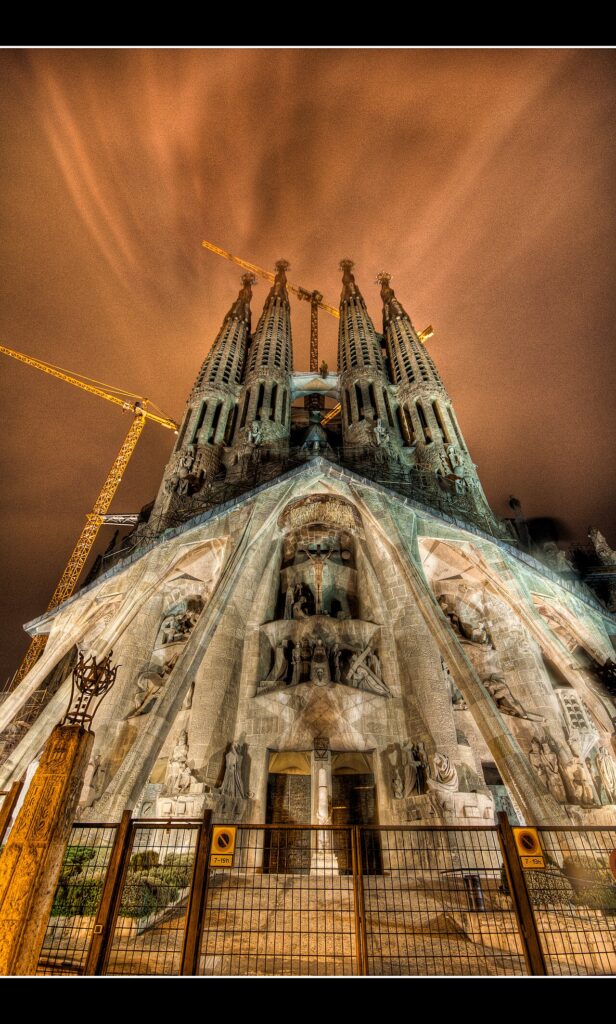
Rising above Barcelona’s Eixample district like a forest of stone, the Sagrada Família is the kind of building that stops you in your tracks. Antoni Gaudí’s basilica has been under construction since 1882, and while completion is projected for 2026, the experience of visiting remains utterly extraordinary—a blend of Gothic ambition and Art Nouveau imagination unlike anything else in the world.
Here’s how to make the most of your visit to this UNESCO World Heritage Site, from booking tickets to understanding what makes it so revolutionary.
Book Your Tickets in Advance
The Sagrada Família sells out weeks ahead during high season, so purchase tickets online at least two weeks before your visit. The basic ticket gets you into the basilica, but the guided tour or audio guide options are worth the extra euros—Gaudí’s symbolism runs deep, and you’ll miss half the magic without context.
The ticket that includes tower access takes you up either the Nativity or Passion facade. The Nativity facade offers better views of the city and shows Gaudí’s original work, while the Passion facade has a more modern elevator. Fair warning: the spiral staircases back down are tight and not for anyone with claustrophobia or mobility issues.
Book the earliest slot available, ideally 9:00 a.m. The light is softer, the crowds are thinner, and you’ll have the nave mostly to yourself for those first precious minutes.
What to Look for Inside
Step through the doors, and your eyes go straight up. The columns branch like trees toward a canopy ceiling, and Gaudí designed every angle deliberately—this is architecture that mimics a forest, with light filtering through leaves of stained glass.
The stained glass windows are the real showstopper. The eastern Nativity facade glows with cool blues and greens in the morning, representing birth and life. Walk to the western Passion facade in the afternoon, and you’re bathed in warm reds and oranges, symbolizing Christ’s suffering and death. Gaudí planned it this way, using the sun’s path to tell the story.
Don’t miss the apse, where seven chapels radiate outward, each dedicated to one of the Virgin Mary’s seven joys and sorrows. Look up at the skylight—it’s a riot of color and geometry that feels almost kaleidoscopic.
In the crypt below, you’ll find Gaudí’s tomb. He’s buried in the Chapel of El Carmen, a simple resting place for a man who spent his final years living on-site in his workshop, entirely consumed by this project.
The Facades: Reading Gaudí’s Bible in Stone
The basilica will eventually have three grand facades, each telling a different part of the Christian story. Two are complete, and the third—the Glory facade on Carrer de Mallorca—is still under construction.
The Nativity facade, facing Carrer de Marina, is the only one Gaudí lived to finish. It’s exuberant, chaotic, covered in sculptures of animals, plants, and angels. Look for the turtle and tortoise at the base of the columns—they symbolize the sea and land, holding up the church.
The Passion facade, facing Carrer de Sardenya, was completed by sculptor Josep Maria Subirachs and is starkly different—angular, haunting, almost brutal. The figures are gaunt and stylized, showing Christ’s crucifixion in sharp relief. Gaudí wanted it this way, knowing this facade would be finished long after his death.
The Museum and Gaudí’s Workshop
Included in your ticket, the museum downstairs is more fascinating than most visitors expect. You’ll see Gaudí’s original plaster models, some of which were smashed during the Spanish Civil War and painstakingly reconstructed. There are hanging chain models—Gaudí’s ingenious method for calculating structural loads by letting gravity do the math.
The workshop area shows architects and craftsmen still at work, carving stone and testing designs. It’s a reminder that this is a living building, still evolving, still being argued over by engineers and artists.
Practical Tips for Your Visit
The basilica sits at the intersection of Carrer de Mallorca and Carrer de Marina. The closest metro stops are Sagrada Família (L2 and L5)—you’ll exit and see the spires immediately.
Security is airport-level strict. Don’t bring large bags, and expect to go through a scanner. Shoulders and knees must be covered; they will turn you away in a tank top or short shorts.
The surrounding park, particularly on the Nativity facade side, offers the best views for photos. Go at sunrise if you’re serious about photography—the light on the eastern facade is golden, and you’ll avoid the tour groups.
If you want to linger, the neighborhood of Eixample around the basilica has excellent cafés. Try Federal Café on Carrer del Parlament for a post-visit coffee, or head to Cal Pep near the Born for seafood tapas.
Visiting the Sagrada Família isn’t just sightseeing—it’s encountering a vision so singular it’s still being translated into stone more than a century later. Give it the time it deserves.
Want more stories from Spain’s greatest landmarks, cities, and hidden corners? Subscribe to the Love Spain newsletter—one short story a day, straight to your inbox.