
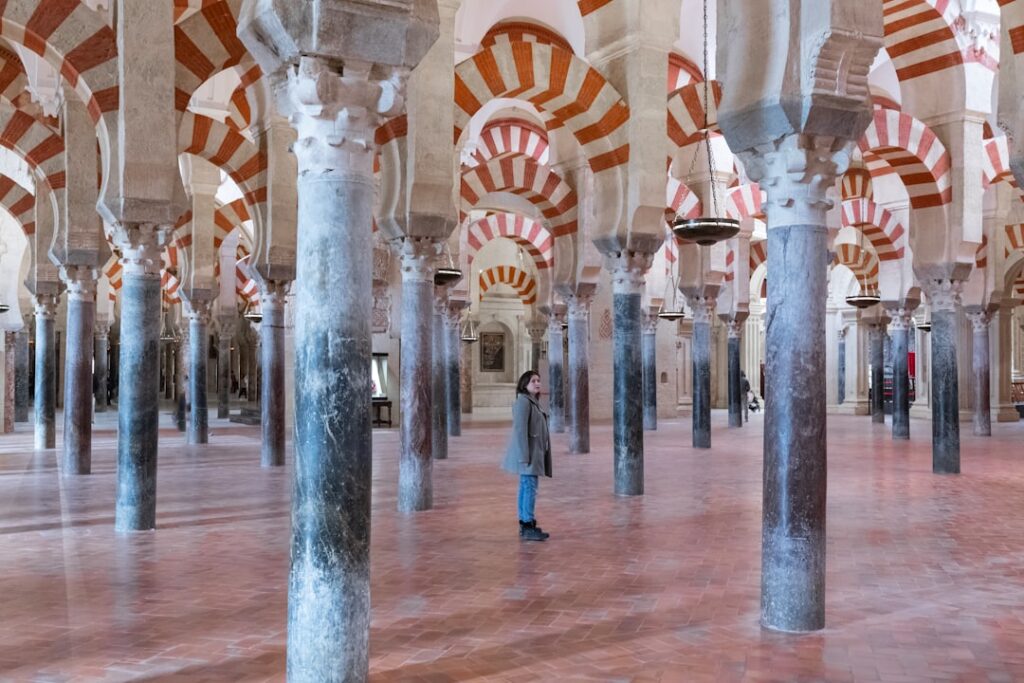
Walking into the Mezquita-Catedral de Córdoba feels like stepping between worlds. The forest of 856 columns creates a hypnotic pattern of red-and-white striped arches that seems to stretch into infinity. This isn’t just one of Spain’s greatest landmarks—it’s a singular architectural achievement that tells the story of Andalusia itself, where Islamic, Christian, and Jewish cultures layered one atop another for centuries.
Inside the Great Mosque-Cathedral
The Mezquita began as a mosque in 785 under Abd al-Rahman I and was expanded over two centuries into one of Islam’s largest places of worship. After Córdoba’s Christian reconquest in 1236, the building was consecrated as a cathedral, and in the 16th century, a Renaissance nave was inserted directly into the center of the prayer hall—a controversial move even at the time. Emperor Charles V, who authorized it, later regretted the decision when he saw the result.
Today, that collision of styles creates the building’s strange power. Buy your tickets online in advance—lines can stretch an hour or more in summer—and arrive when doors open at 10 a.m. or after 7 p.m. for the evening visit. The morning light filtering through the arches is particularly beautiful. Don’t miss the mihrab, the ornate prayer niche decorated with Byzantine mosaics of gold and lapis lazuli, or the Patio de los Naranjos, the orange tree courtyard where worshippers once performed ablutions.
Audio guides are worthwhile, but consider a guided tour to understand the architectural layers. The cathedral’s treasury and choir stalls are masterworks in their own right, even if the Renaissance insertion still divides opinion.
The Judería and Roman Bridge
The Mezquita sits at the edge of the Judería, Córdoba’s medieval Jewish quarter. Lose yourself in these whitewashed lanes, where geraniums cascade from wrought-iron balconies and the walls stay cool even in August heat. Stop at the Sinagoga on Calle Judíos, one of only three medieval synagogues surviving in Spain, and visit the Casa de Sefarad museum to learn about Córdoba’s once-thriving Jewish community.
Walk south from the Mezquita to the Puente Romano, the 16-arched Roman bridge spanning the Guadalquivir River. The Torre de la Calahorra at the far end houses a museum on Córdoba’s convivencia—the medieval period of coexistence among the three cultures. At sunset, the view back toward the Mezquita from the bridge is unforgettable, the honeyed stone glowing against the sky.
Where to Eat in Córdoba
Córdoba has its own culinary identity within Andalusia. The signature dish is salmorejo, a thick, cold tomato soup topped with hard-boiled egg and jamón—smoother and richer than gazpacho. Rabo de toro (oxtail stew) is another local specialty, slow-braised until the meat falls off the bone.
For traditional tapas, head to Bodegas Mezquita Céspedes on Calle Céspedes, a no-frills spot where locals pack the bar. Try the berenjenas con miel (fried eggplant with honey), a Córdoban classic that balances savory and sweet. Taberna Salinas on Calle Tundidores serves excellent salmorejo and flamenquines, breaded pork rolls stuffed with ham.
For something more refined, Noor earned a Michelin star for its reinterpretation of medieval Andalusian cuisine, using historical recipes from the Caliphate era. Reserve well ahead.
Beyond the Center: Patios and Palaces
If you visit in early May, you’ll catch the Festival de los Patios, when residents open their private courtyards to the public. These hidden patios, decorated with hundreds of potted plants and ceramic tiles, are a Córdoban tradition dating back centuries. Even outside festival time, you can visit several patios in the San Basilio neighborhood year-round.
Don’t skip Medina Azahara, the ruins of a 10th-century palace city built by Abd al-Rahman III eight kilometers west of Córdoba. This once-glittering capital was destroyed in civil war just decades after completion, but recent excavations have revealed the scale of its ambition. A shuttle bus runs from the visitor center to the archaeological site. The views over the Sierra Morena foothills alone are worth the trip.
Practical Details
Córdoba sits on the Madrid-Seville high-speed rail line, about 45 minutes from Seville and 90 minutes from Madrid. Most visitors come as a day trip, but staying overnight lets you experience the city after tour buses depart. The narrow streets and evening paseo take on a different character at dusk.
Summer temperatures regularly top 40°C (104°F)—Córdoba is one of Europe’s hottest cities. Spring and fall are ideal; winter is mild and uncrowded. Plan your sightseeing for early morning and late afternoon, and embrace the siesta. The city slows to a crawl between 2 p.m. and 5 p.m., when shops close and locals retreat indoors.
The Mezquita dominates any visit, but Córdoba rewards those who linger. The layers of history, the intensity of the light, the taste of salmorejo in a cool taberna—this is Andalusia at its most essential, where the past is never quite past and beauty emerges from unexpected juxtapositions.
Want more insider guides to Spain’s most captivating destinations? Subscribe to the Love Spain newsletter and get one short story a day delivered to your inbox.